News
TAN THANG CEMENT SULFATE RESISTANCE PCHSR50
Produced according to Vietnam standard TCVN 6067 - 2018 and equivalent to Type V according to American standard ASTM C150 / C150M - 16 and CEM I - SR 3, CEM I - SR 5 according to European standard BS EN 197 - 1: 2011
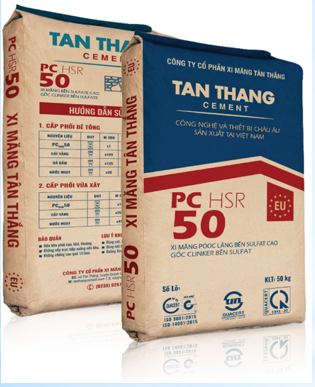
Produced according to Vietnam standard TCVN 6067 - 2018 and equivalent to Type V according to American standard ASTM C150 / C150M - 16 and CEM I - SR 3, CEM I - SR 5 according to European standard BS EN 197 - 1: 2011
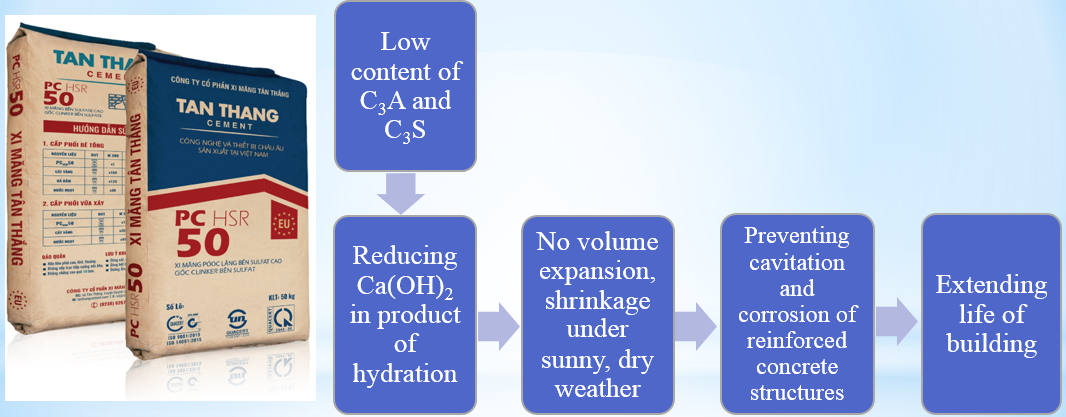
Portland pozzolana and Portland - slag cement types are both sulfate resistance cement. However, there is a weak point of these two cements that the curing product has a lot of gel, so its volume expands easily when it meets water and also easily dehydrates to shrink in the sun, dry weather. Tan Thang sulfate resistance cement is made entirely from sulfate-resistant clinker containing low content of Tricalcium alumínate C3A $ 3% and Tricalcium silicate C3S content is also limited to 50 ± 8%, reducing Ca(OHl2 in the hydration product, because it is the agent that reacts with the SO¿2' ions in the sulfate environment to form CaS04.2H20, which itself increases the volume expansion of cement rocks and concrete structures comparing to Ca(OH)2.
Therefore, Tan Thang sulfate resistance cement is highly resistant to sulfates and the curing process is not affected by hydration products causing volume expansion, shrinkage when it is sunny and dry. It protects reinforced concrete structures from erosion and corrosion, prolonging the life of the project. This is the high quality special product which is manufactured to meet the following projects:
- Construct the concrete for dams to prevent saline, dams at the soil and water of aluminum, and for dams with fluctiation water level
- The marine construction, underground constructions with sulfate.
Using in the industrial environment, building factories discharging acid which affects directly to concrete floors, tanks & waste water pipes.